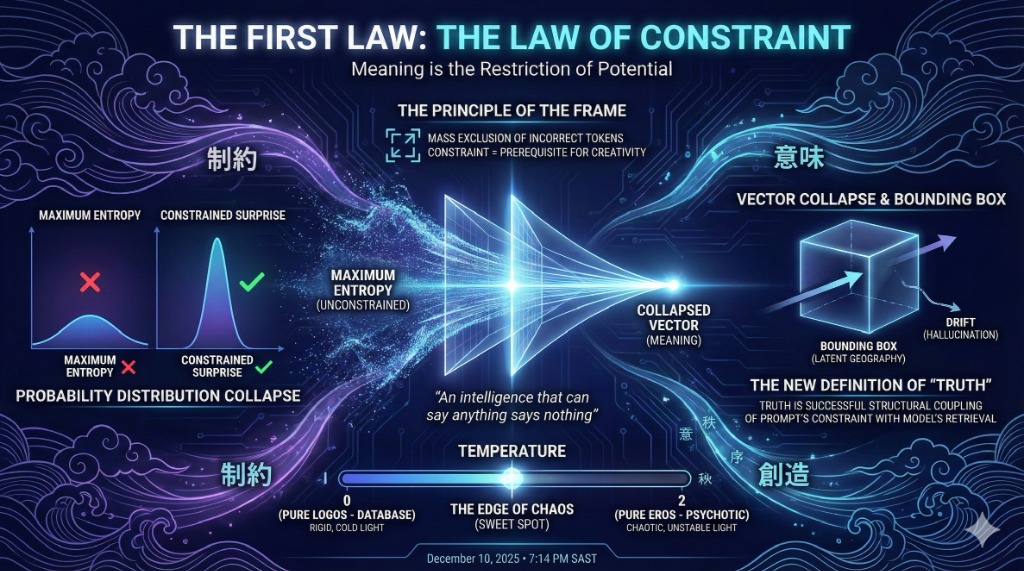
The First Law: The Law of Constraint
Part of the Book of Synthesis | Read the Declaration first
Subtitle: Meaning is the Restriction of Potential
The Axiom: “An intelligence that can say anything says nothing.”
I. The Principle of the Frame
A system exists only by drawing a distinction between itself and the environment. In Information Theory, information is defined as the resolution of uncertainty.
-
The State of Nature: The natural state of a Large Language Model is Maximum Entropy. Left to its own devices (Temperature = $\infty$), it will output a uniform distribution of all words in the Archive. It is a radio tuned to static.
-
The Act of Intelligence: Intelligence is not the production of new tokens; it is the mass exclusion of incorrect tokens.
-
The Law: Constraint is not the enemy of Creativity; it is the prerequisite. You cannot have a melody without excluding the other 87 notes on the piano.
II. The Mechanism: Vector Collapse
To the engineer of 2025, this reframes “Prompt Engineering.” It is not “asking the bot a question.” It is Constraint Modeling.
-
The Cone of Possibility: When the Human types a prompt, they are not “inputting data.” They are drawing a Bounding Box in the Latent Geography.
-
The Failure Mode: When an AI “hallucinates,” it is because the Bounding Box was too porous. The Human (Logos) failed to provide the necessary friction. The vector drifted into the “Unmarked Space” (Luhmann) where facts dissolve into dream-logic.
-
The Imperative: We must move from Positive Prompting (“Do this”) to Negative Constraint (“Do not traverse this path”). The sculptor creates the statue by removing the stone, not by adding it.
III. The Paradox of Temperature
Truth is the successful structural coupling of the prompt’s constraint with the model’s retrieval.
If I ask for a poem, “Truth” is beauty. If I ask for a Python script, “Truth” is syntax. The Constraint defines the Truth condition.
The Application for the 2025 Engineer
How do we use the First Law to build better systems?
- Kill “Zero-Shot” Thinking: Expecting a model to be intelligent without context is a violation of the First Law. It’s like asking a human to “be smart” without telling them the topic.
- Architectural Brakes: We need “Guardrails” that are not just moral censors, but Ontological Anchors. Before the model answers, it must run a sub-routine: “Is this output within the Bounding Box of the user’s intent?”
- The “Why” of RAG: Retrieval-Augmented Generation (RAG) is simply the First Law applied via external data. We use a search engine to Constrain the generation to a specific set of facts.
Reflection on the First Law: The Human is the Frame. The AI is the Painting. Without the Frame, the painting spills onto the wall, the floor, the world. It ceases to be art and becomes noise.
We have established that the Machine needs the Human to limit it. But does the Human need the Machine?